
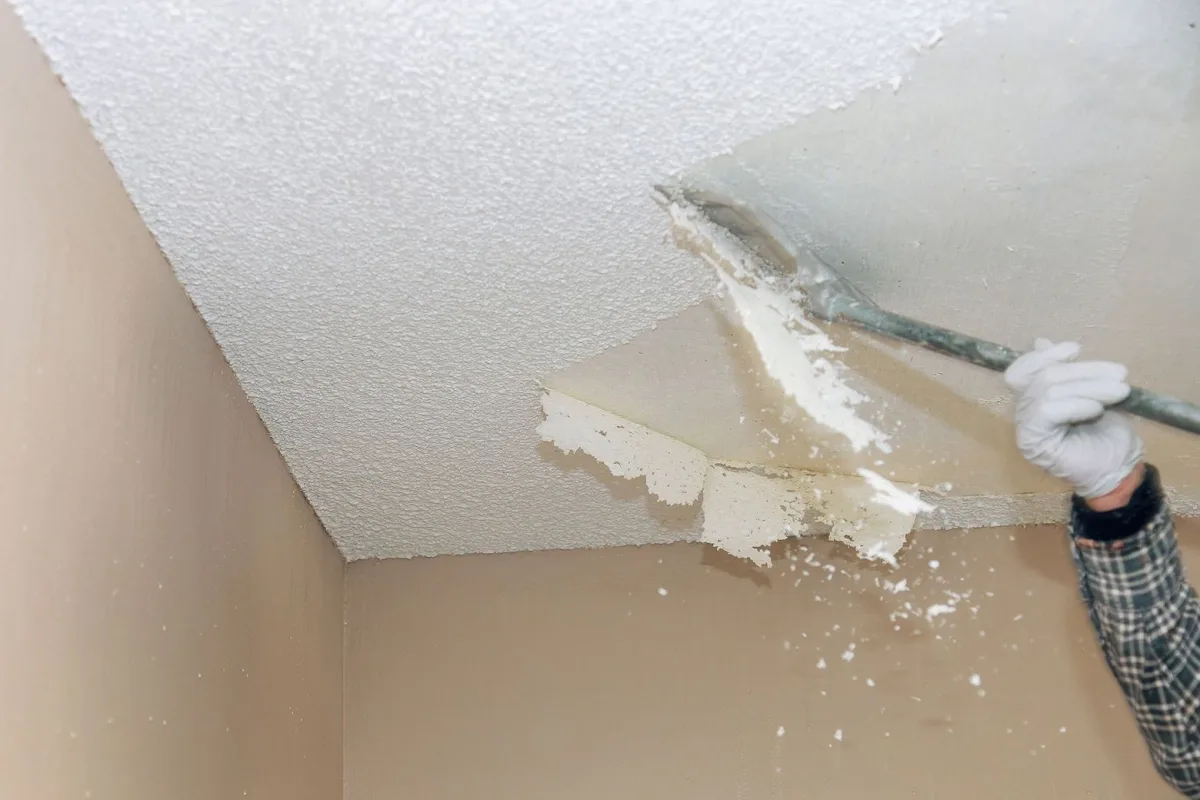
Popcorn Ceiling Asbestos: What California Homeowners Need to Know
If your home was built before about 1990, test the ceiling before you touch it. Undisturbed popcorn texture is a low risk, and scraping it is what releases fibers. A lab result is the only way to know what is up there.
Does My Popcorn Ceiling Have Asbestos?
Age is your first clue. Sprayed ceiling texture went into California homes from the 1950s through the 1980s. Asbestos was common in the mix for much of that stretch.
You cannot tell by looking. Asbestos fibers are far too small to see. Two ceilings can look identical and come back with opposite lab results.
The same house can give you different answers room to room. Additions and remodels put new material on the ceiling at different dates. A sample from the hallway does not tell you what is in the back bedroom.
A rough guide by build year:
- Before 1978: treat it as asbestos until a lab says otherwise
- 1978 to 1985: still likely, because leftover stock kept getting sprayed
- 1985 to 1990: less likely, and still worth a test before you scrape
- After 1990: unlikely, unless someone re-textured over an older ceiling
Why Was Asbestos in Ceiling Texture?
Asbestos was cheap and it worked. It made the texture fire resistant, and it helped the sprayed mix bind to the ceiling. It also deadened sound, which is why these got sold as acoustic ceilings.
Federal rules closed in on it in stages. In 1973 the EPA banned spray-applied asbestos surfacing used for fireproofing and insulating. In December 1977 the Consumer Product Safety Commission banned consumer patching compounds containing respirable free-form asbestos.
The CPSC ban took hold in two steps. Product made or first sold after January 16, 1978 was banned right away. Everything else was banned as of June 11, 1978.
In 1978 the EPA closed the rest of the gap. It banned the spray-applied surfacing uses it had not already covered, which caught decorative ceiling texture.
None of that emptied the warehouses. Existing inventories of asbestos-bearing texture were not recalled, so crews kept spraying what they already had. That is why ceilings applied through the 1980s can still test positive.
Is It Dangerous to Leave It Alone?
Often, no. The EPA is direct about this: asbestos-containing materials that are not damaged or disturbed are not likely to pose a health risk.
A painted, intact popcorn ceiling that nobody bumps into is not an emergency. The fibers stay bound in the material. They become a hazard once they get into the air.
Damage is what changes the math. The EPA lists the risky moments as when material gets cut, torn, sanded, sawed, drilled, or scraped. Every one of those is something a remodel does to a ceiling.
Watch for signs the material is no longer stable:
- Water stains or a sagging section
- Texture flaking or shedding onto the floor
- Cracks around a light fixture or an old patch
- Grit and debris landing on furniture below
You also have a middle option. The EPA calls it repair, and the trade calls it encapsulation. You seal the surface with a coating, or you enclose it under new drywall.
Encapsulation costs less than removal and it keeps the fibers locked down. The trade-off is that the asbestos is still up there. You have to tell any future buyer and any contractor who works overhead.
How Does Testing Work in California?
Start with what the EPA says about doing it yourself: taking samples yourself is not recommended. A careless sample can put more fiber in the air than the intact ceiling ever would.
California adds a certification rule on top. Cal/OSHA requires certification for the people who take asbestos samples. The same rule covers planning and oversight of removals at 100 square feet or more.
So a Certified Asbestos Consultant or Certified Site Surveillance Technician pulls the samples. Most popcorn ceilings clear 100 square feet in a single room, so that threshold catches almost every house.
A real sample visit is quick and dull. The consultant wets the spot and cuts out a piece about the size of a quarter. It goes into a sealed container, and the hole gets patched. They pull several samples from different rooms and different eras of the house.
The samples go to a lab accredited by NVLAP, the national lab accreditation program. The lab reads them under polarized light microscopy and reports a percentage. Results usually come back in a day or two.
That percentage decides what happens next. Cal/OSHA’s contractor registration rule kicks in on material above 0.1 percent asbestos. Cost guides put testing and inspection at $250 to $850.
What Does Licensed Removal Look Like?
California is strict about who is allowed to do this work. Business and Professions Code section 7058.5 covers asbestos work of 100 square feet or more. The contractor needs the C-22 Asbestos Abatement classification, or the license qualifier passes the state asbestos certification exam.
The company also registers with Cal/OSHA. Registration applies to work involving 100 square feet or more of material above 0.1 percent asbestos. Below that size, the employer files a report of use with Cal/OSHA instead.
Your local air district wants notice too. The Bay Area air district asks for notice at least 10 business days ahead. That applies to any renovation removing 100 square feet or more of asbestos. Homes of four or fewer units can give 72 hours notice with an added fee.
Other districts run their own version of that rule. The notice window depends on where you live.
The removal itself follows a set order:
- Clear the room and seal every vent and doorway with plastic
- Build containment and run negative air machines with HEPA filters
- Wet the texture down so fibers stay put as it comes off
- Scrape wet, then bag the waste in labeled, sealed bags
- HEPA vacuum and wet wipe every surface inside the containment
- Run clearance air testing before the plastic comes down
- Haul the waste to a landfill permitted to accept asbestos
Crews work in respirators and disposable suits the whole time. Licensed asbestos abatement is a controlled process, and the containment is what protects the rest of your house.
Timing matters when the ceiling is part of a bigger project. Abatement has to finish and pass clearance before the interior demolition phase opens up walls or pulls framing. Running them out of order contaminates the whole work area.
What Does Removal Cost?
We will not quote your house from an article. Here is what published cost guides report, so you have a starting frame.
| Item | Published range | Source |
|---|---|---|
| Asbestos testing and inspection | $250 to $850 | Bob Vila, HomeAdvisor |
| Popcorn ceiling asbestos removal | $3 to $7 per sq ft | Bob Vila |
| Textured ceiling asbestos removal | $9 to $20 per sq ft | HomeAdvisor |
| Encapsulation instead of removal | $2 to $6 per sq ft | Bob Vila |
| Whole asbestos job, typical range | $1,192 to $3,240, average $2,201 | Bob Vila |
| Disposal permit | $50 to $100 | HomeAdvisor |
Those two per-foot lines are far apart, and that gap is real. Guides survey different jobs, and a one-room scrape prices very differently from a whole-house abatement.
Your number moves with square footage and ceiling height. Room count matters too, because each sealed area is its own setup. So does the haul distance to a permitted landfill. New drywall finish and paint come after the abatement, on a separate line.
None of these figures are our prices. Published ranges are a sanity check on a bid, not a quote.
What To Do Next
If the ceiling is intact and painted and nobody is touching it, you have time. Get it tested before you hang a ceiling fan or start any remodel. The result decides whether this is a paint job or an abatement job.
If it comes back positive, you still get to choose. Sealing it is a legitimate answer when you are not opening the ceiling up. Removal is the answer when the material is damaged or when the remodel is coming anyway.
We handle asbestos abatement across Northern California, and estimates are free.