
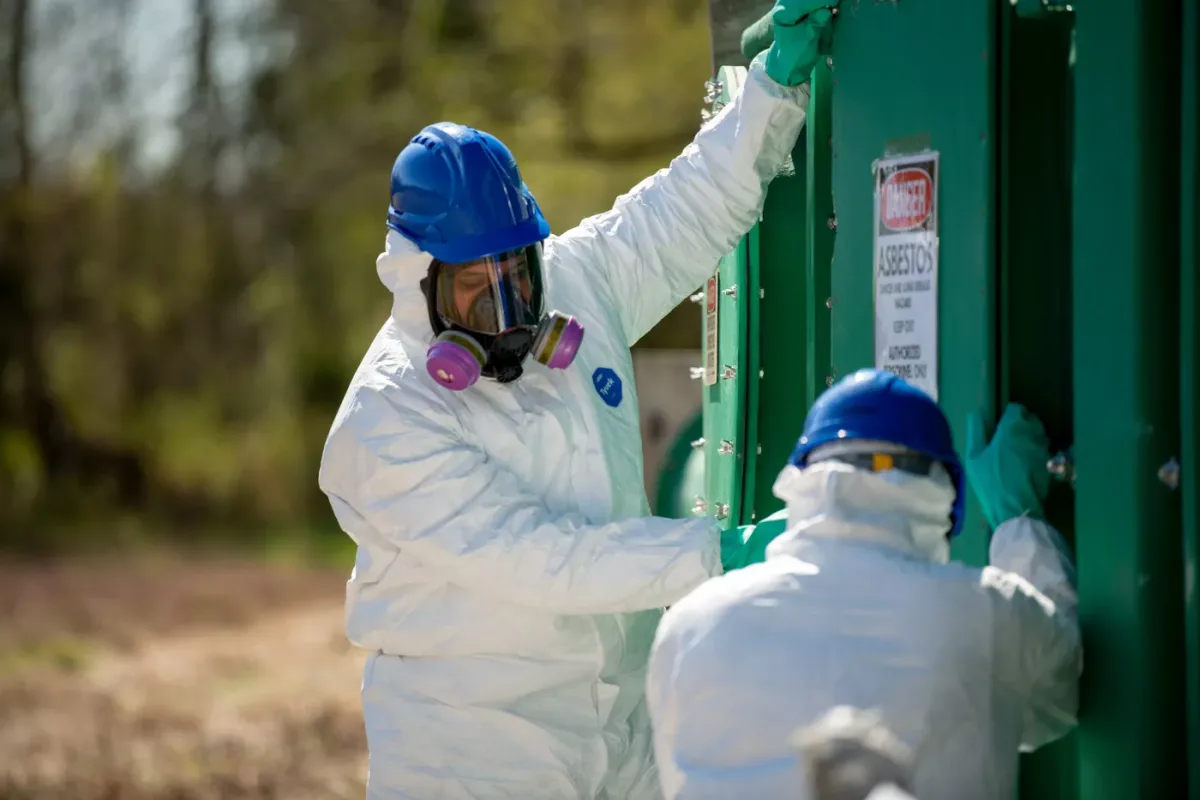
Asbestos Testing Before Demolition and Renovation in California
Yes, in almost every case. California air districts require an asbestos survey before a demolition permit is released. Buildings from 1980 and earlier get the strictest treatment, and testing is a separate job from removal.
We do abatement and demolition. We do not test, and we cannot test on a job we might remove. Here is how the process runs and where we pick it up.
When Is Asbestos Testing Required in California?
The requirement comes from the federal asbestos NESHAP rule. Local air districts enforce it here, and each one publishes its own version. Before a regulated building is demolished or renovated, an inspection for asbestos has to happen.
Demolition is the strict case. The San Joaquin Valley Air District says all suspect material in the structure must be tested first. The district then signs a release form. Your city or county needs that signed form before it will issue the demolition permit.
The Bay Area Air District goes further. It requires notice before every demolition, whether or not asbestos is present. Santa Cruz County falls under the Monterey Bay Air Resources District. That district asks for a third party CAC inspection and 10 working days of notice.
So the answer changes a little by address. Sacramento, Stockton, Modesto, and San Jose each sit under a different air district with its own forms and fees. What does not change is the survey itself. Every district in our service area wants one before a structure comes down.
Renovation runs on quantity thresholds. Federal notification applies once the work will disturb:
- 260 linear feet or more of asbestos on pipes
- 160 square feet or more on other building components
- 35 cubic feet or more where the amount cannot be measured another way
Age matters on top of that. Cal/OSHA presumes that thermal system insulation and surfacing material contain asbestos in buildings built no later than 1980. Popcorn ceilings and pipe wrap sit in those two categories. Only a lab result can rebut the presumption.
Who Does the Testing? (and why it is not the abatement contractor)
In California, building asbestos surveys belong to a Cal/OSHA Certified Asbestos Consultant, or CAC. A Certified Site Surveillance Technician may collect samples under a CAC’s direction. The CAC writes the report your air district and building department will read.
Samples go to an accredited lab. The lab determines whether the material contains asbestos and at what percentage. The consultant interprets that result and puts it in the survey report.
Cal/OSHA keeps the two sides apart on purpose. Its rules bar a consultant from holding a financial interest in the abatement contractor. That bar applies to any contractor hired for the same project, and it covers site surveillance technicians too. State law also says a licensed contractor may not perform asbestos risk assessment.
The reason is simple. A company paid to remove asbestos should not be the company deciding how much you have. That is why we stay out of testing. Send us the CAC report and we price the removal from it.
One narrow exception sits in state law. A licensed contractor may take up to 12 bulk samples of suspect material. That allowance covers limited purposes like preparing a bid, and those samples do not replace the survey your permit needs.
Homeowners often ask about sampling their own house. EPA does not recommend it and says a trained, accredited professional should take the samples. Bad sampling can release fibers that were sitting still. For permit work, the report has to come from a CAC anyway.
What Does a Survey Cover and Cost?
A demolition survey has to reach every material in the structure. That covers what sits behind finishes and under floors. A renovation survey is narrower and covers only what your work will disturb. A limited survey will not satisfy a demolition requirement.
Materials that usually get sampled:
- Popcorn ceilings and other textured ceiling coatings
- Wall and ceiling patching compound, drywall joint compound, plaster, and stucco
- Vinyl floor tile, sheet flooring backing, and the mastic underneath
- Attic and wall insulation, including vermiculite
- Pipe wrap, boiler insulation, and furnace door gaskets
- Siding shingles, roofing shingles, and roofing felt
Cost is set by the consultant, never by us. Fixr publishes national figures that put typical asbestos testing at $250 to $750, with an average near $500. Fixr lists a demolition or refurbishment survey higher, at $900 to $1,200. Air testing lands at $300 to $1,200 in the same data.
Your quote will depend on building size and how many distinct materials need sampling. A tract house with two flooring layers costs less than a 1940s farmhouse with additions. Air district notification fees are separate and vary by district. Ask the consultant for a written price before sampling starts.
The visit itself is short. The consultant cuts small pieces from each suspect material and bags them. Each material and each layer counts as its own sample, which is why sample count drives the price.
What Happens if the Test Comes Back Positive?
A positive result is common in older buildings. It changes your schedule and your budget. The project still gets done.
Removal moves to a contractor registered with Cal/OSHA for asbestos work. Registration is required for material above 0.1 percent asbestos. It also applies at 100 square feet or more of surface area. California contractors carry the CSLB asbestos certification at that same threshold.
Notification goes to your air district before work starts. Most districts want it at least 10 working days ahead. The Bay Area district has a shorter option for small residential buildings. Homes with four or fewer units can give 72 hours notice for an added fee.
The work itself happens inside containment, under negative air pressure with filtered exhaust. Waste goes to a landfill permitted for asbestos. Our page on asbestos removal covers what that step looks like day to day.
Clearance closes it out. A CAC performs the visual inspection and the clearance air monitoring after removal. Once clearance passes, containment comes down and the building is released for demolition.
Keep the paperwork. The survey, the notification, the waste receipts, and the clearance report form the record for your permit file. Buyers, lenders, and inspectors ask for it later.
How Testing Fits the Demolition Timeline
Most jobs run in this order:
- Hire a CAC and get the survey. Ask about lab turnaround when you book.
- Submit the survey and the notification to your air district. Count 10 working days.
- Abate what the survey found. Duration depends on how much material there is.
- Get the clearance report from the CAC.
- Pull the demolition permit with the district release form attached.
- Demolish.
The survey is the gate. Nothing after it can start until the report exists, so book the consultant first. Owners who skip this step get sent back by the building department.
Once the structure is clear, the teardown is the simple part. Our house and structure teardown work covers houses, garages, additions, and outbuildings across the Central Valley, Bay Area, Sacramento, and Santa Cruz.
Our family has done this work since 1967, and we hold CSLB license #247684 and Cal/OSHA registration #507. Send us your survey report and we will price the abatement and the demolition that follows. Estimates are free.