
Commercial demolition cost in California: what does it take to tear down a commercial building?
Commercial demolition cost runs $4 to $7 per square foot, according to HomeGuide. CommLoan, a commercial real estate lending marketplace, gives $4 to $25, and its range climbs with building size. Asbestos work adds to both. In California, every commercial demolition also needs an asbestos inspection and an air district notice first.
What does commercial demolition cost per square foot?
HomeGuide’s range of $4 to $7 per square foot depends on project size, building materials and location, it says. Its commercial demolition cost calculator applies that rate to four building types.
| Building type | Size | HomeGuide total |
|---|---|---|
| Shop | 1,000 sq ft | $4,000 to $7,000 |
| Restaurant | 2,000 sq ft | $8,000 to $14,000 |
| Office | 8,000 sq ft | $32,000 to $56,000 |
| Warehouse | 12,000 sq ft | $48,000 to $84,000 |
Source: HomeGuide’s commercial demolition cost calculator. HomeGuide says these totals include debris disposal.
Divide any row’s total by its size and you get the same $4 to $7 per square foot. To run that math on your own building, multiply its square footage by $4 and by $7.
CommLoan gives a wider range of $4 to $25 per square foot, and its band climbs with size. From 1,000 to 5,000 square feet, CommLoan lists $4 to $8 per square foot. From 5,001 to 10,000 square feet, it lists $8 to $12.
Buildings of 10,001 to 20,000 square feet run $12 to $18 per square foot. From 20,001 to 50,000 square feet, the band is $18 to $25. Past 50,000 square feet, CommLoan lists $25 or higher.
The two guides read size in opposite ways. HomeGuide says heavy machinery lowers the cost per square foot on larger projects. CommLoan’s band goes up as the building gets bigger.
At the small end, the two land close together. A 5,000 square foot building works out to $20,000 to $35,000 at HomeGuide’s rate. CommLoan’s first tier gives $20,000 to $40,000 for the same building.
The gap opens on bigger buildings. CommLoan’s tier for a 12,000 square foot warehouse works out to $144,000 to $216,000. HomeGuide’s total for the same warehouse is $48,000 to $84,000.
So treat any per-square-foot figure as a starting budget. The price comes from a bid on the building itself. We do commercial demolition on buildings up to two or three stories tall.
What moves commercial demolition cost up or down?
CommLoan calls size the most significant factor in the cost to demolish a commercial building. Larger buildings have more material, it says. It adds that taller buildings cost more to demolish than smaller ones.
Building materials and the foundation count too. HomeGuide ties its range to building materials, and it says foundation removal raises the overall cost. If the slab and footings have to come out, check that every bid includes them.
The building’s past use matters as well. In CommLoan’s view, an office building or industrial warehouse tends to cost less to take down. Sports facilities and hazardous materials plants cost more to remove.
Location and access move the price too. CommLoan says costs in urban city centers tend to be much higher than in smaller cities. A building that is hard to reach because of its height or placement also costs more.
Condition and paperwork can add cost as well. CommLoan says a building in poor condition may need to be stabilized before it comes down. It says some contractors include the permit in the demolition cost, but not all do. In some cases, CommLoan says, permitting can add several thousand dollars.
Asbestos adds its own line. CommLoan lists asbestos removal as an added cost when needed. If asbestos is found, it says, that could add $2 to $3 per square foot. HomeGuide also says asbestos raises the overall cost.
Utilities have to be shut off and cleared before the building comes down, and that takes paperwork. In Hayward, when utilities are removed under the demolition permit, the city wants a letter from PG&E. That letter certifies the services were safely disconnected.
Debris is the last big line. HomeGuide’s table totals include debris disposal, so ask whether each bid does too.
Why does asbestos come first on a commercial building?
The federal asbestos rule, called NESHAP, covers any institutional, commercial, public or industrial building. It leaves out only residential buildings of four or fewer units. So every commercial demolition falls under it. A house is a different job, covered in our house demolition cost guide.
Before work starts, the building must be thoroughly inspected for asbestos. Written notice then goes in at least 10 working days before the work begins. Our guide to asbestos testing before demolition explains who does the survey.
Local air districts layer their own steps on top. In the San Joaquin Valley, the air district signs a Demolition Permit Release form first. Only then does the city or county issue the demolition permit.
In the Bay Area, every demolition gets reported to the air district, whatever its asbestos content. That notice is due at least 10 business days ahead. Hayward’s demolition checklist ties it to the city permit. It asks for the air district’s job number, or J number, for any structure of 100 square feet or more.
Sacramento County falls under the Sac Metro Air District. Its Rule 902 covers every commercial demolition that removes load bearing or structural elements. Those demolitions need 10 working days of advance notice, plus fees.
Before any asbestos job of 100 square feet or more, the contractor needs Cal/OSHA registration. The sampling belongs to a certified asbestos consultant, and the asbestos removal is our part. Build the survey and the abatement into both the budget and the schedule.
What do debris and recycling add to commercial demolition cost?
Debris is a cost of its own, and state rules shape where it goes. CALGreen sets the floor at 65 percent of a covered project’s nonhazardous construction and demolition debris, recycled or salvaged.
A city can set the bar higher. Hayward wants 100 percent of asphalt, concrete and similar material recycled, on top of its 65 percent minimum. Hayward also wants every weigh tag turned in before the final inspection on projects valued over $75,000.
Dump fees depend on the site and the load. Stanislaus County’s Fink Road Landfill lists $49.68 per ton for normal refuse, in prices effective July 10, 2025. Its normal refuse category takes in demolition and construction debris.
Sacramento County’s Kiefer Landfill shows why sorting pays. Under its 2026 fees, Kiefer takes clean concrete without rebar, with no dirt or trash mixed in, at no fee. Large or bulky material costs $144.90 per ton. Oversized chunks, more than three feet across, land in that bulky class, and so does concrete with excessive rebar.
CommLoan says disposal costs less when some materials can be recycled. Sorting those materials plays a role in cost too, it adds. It also flags added transportation costs when the nearest landfill is some distance away.
Breaking out slabs and footings is concrete demolition. We sort concrete and steel for recycling on our commercial jobs.
What if you need a strip-out instead of a teardown?
Some commercial jobs leave the building standing. A strip-out takes a tenant space back to the shell for the next build-out. That work is interior demolition, and it can still need a demolition permit.
Hayward requires a demolition permit for removing a whole building, part of a building or an interior tenant space. For the city and air district paperwork, see our demolition permit guide.
Commercial interior demolition cost sits at $4 to $8 per square foot in HomeAdvisor’s guide. Its figure for 10,000 square feet is $40,000 to $80,000. Commercial work runs slightly higher than residential demo, HomeAdvisor says, because of specialized permits and fees. Per-room ranges for interior work sit in our interior demolition cost guide.
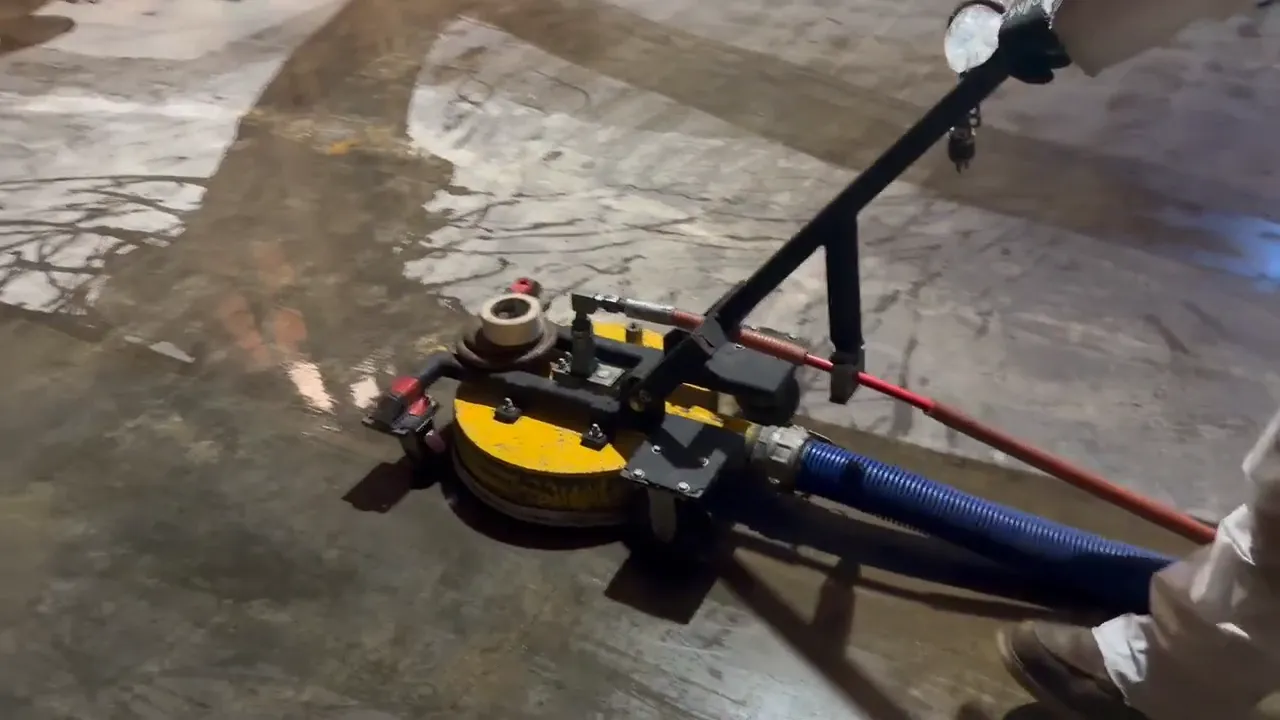
When a strip-out includes the floors, decades in the flooring business sit behind that work. For asbestos adhesive on a slab, we use water at 40,000 psi with full HEPA vacuum recovery.
How do you get a commercial demolition estimate that holds?
Start with the asbestos survey. A bid written before the survey has to guess at the asbestos. With the report in hand, write down the scope, including whether the slab and footings come out.
Give every bidder the same scope so the numbers line up. Ask for the abatement as its own line, apart from the demolition. CommLoan says contractors should provide a breakdown of all costs, including extras tied to the property type and location.
CommLoan also says true accuracy only comes from a full analysis and a quote from a local contractor. In practice, that means an estimate made on site.
Before you call, note the building’s square footage and how many stories it has. If a consultant has already surveyed it for asbestos, send that report along.
We take down commercial buildings and strip tenant spaces across the Central Valley, the Bay Area and Sacramento. Whole buildings of two to three stories are a sweet spot for us. Heavy high-reach work goes to partner companies.
A family company since 1967, we work under CSLB #247684 and CAL OSHA #507. Our estimates are free and come after a visit to the building. To set one up, contact us or call (209) 652-9206.